
A team finishes on 180 for six and wins by four wickets. Another finishes on 180 for six and wins by 20 runs. The winning total is identical, so why are the result lines different? They describe different situations: completing a chase or defending a score.
The wicket margin is the number of wickets the chasing side still had available when it won. The run margin measures the difference in runs when the side fielding last wins. Neither is the number of wickets taken by the winning team’s bowlers. This guide uses ordinary one-innings examples, with eleven-player sides and no revised targets or penalties unless stated otherwise.
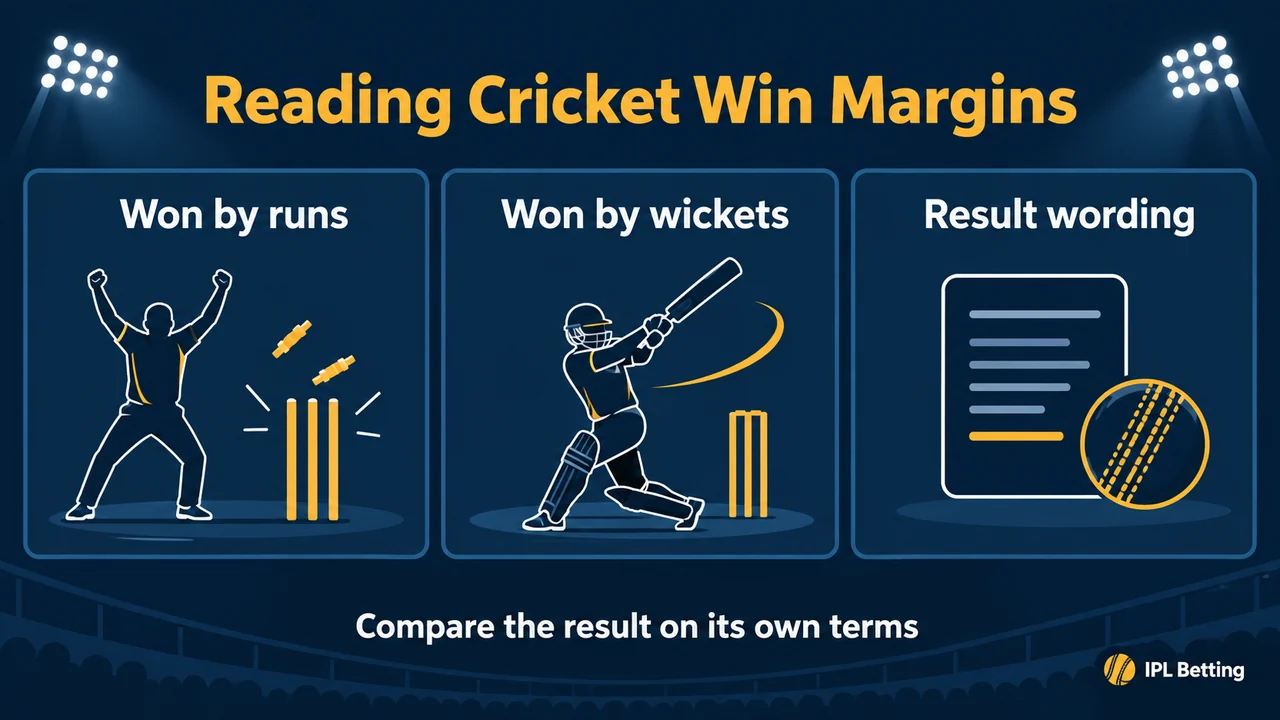
Put the batting order beside the scores
MCC’s Law 16 on the result, section 16.7, distinguishes a win by wickets for the side batting last from a win by runs for the side fielding last. Start by identifying which side batted last. Competition conditions provide additional result procedures, including interruptions and tie-breaks; do not calculate those cases by silently treating them as an uninterrupted match.
Start with who batted first. Then check whether both innings are completed and which side is officially declared the winner. A live score saying “needs one” is still a task in progress. A final result line records that the result has been reached. The camera showing players celebrating can arrive before an app updates its status.
Two fictional matches, one winning total
In Match A, Falcons bat first and finish on 180 for six. Herons complete their innings on 160. Falcons have defended their score and won by 20 runs: 180 minus 160. Falcons’ own six lost wickets do not make this a four-wicket win. The relevant comparison is between the completed team totals.
In Match B, Herons bat first and finish on 179. Falcons chase and reach 180 for six. Their target was 180, and they have reached it with four wickets still available in an ordinary eleven-player innings. The result is a win by four wickets, not one run. The one-run difference between the final totals does not define a chasing victory’s wicket margin.
| Fictional match | First innings | Second innings | Result |
|---|---|---|---|
| A | Falcons 180/6 | Herons 160 | Falcons win by 20 runs |
| B | Herons 179 | Falcons 180/6 | Falcons win by four wickets |
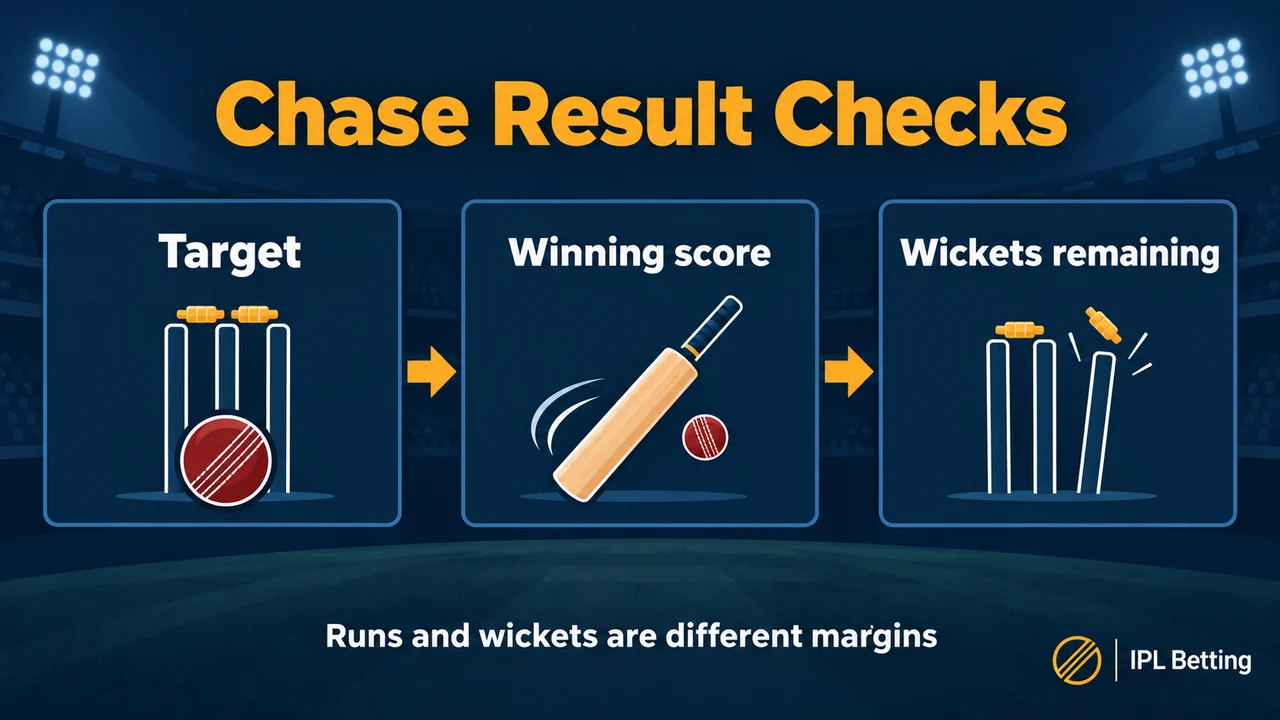
These invented cases hold the winner’s score constant so you can see which variable changes the wording. Read a result from the innings sequence, not from the largest number on a highlight graphic.
Balls remaining answer another question
Suppose Falcons reach their target with four wickets left and five legal balls unused. “Four wickets” and “five balls remaining” describe separate resources. They can both appear in the result summary. Five balls left does not mean five wickets left, and it does not replace the official winning margin.
For a simple viewing note, give each item its own space: target, final score, wickets lost and balls unused. That also prevents an unfinished chase from being mistaken for a completed result. At 174 for six chasing 180, Falcons still need six; there is no four-wicket victory to record yet.
Do not turn either resource into a universal measure of how easy the win was. A chase completed with one ball remaining may have involved a stable partnership; another may have survived a close run-out. The margin describes the finish. The delivery sequence explains how the match reached it.
A winning boundary can take the total beyond the target
Under MCC Law 16.6.3, when the winning boundary occurs before enough runs have already been completed to win, the whole boundary allowance is credited. Imagine Falcons on 178 chasing a target of 180. A valid boundary four can leave the final total at 182 rather than stopping the score at exactly 180.
That example does not convert the victory into a three-run win. If the chasing side still has four wickets to fall, it remains a four-wicket result in this ordinary scenario. Keep the final total and the result description together instead of editing the score to fit the target.
Equal totals need the official next step
Two completed regulation innings on the same score can produce a tie. A competition may then use a tie-break procedure to determine its winner. Record the regulation tie and the tie-break outcome separately; do not invent a regulation run margin by adding tie-break runs to the main innings.
An interrupted-match result requires its own published target and result method. This article’s subtraction examples do not explain DLS margins. If a result carries a DLS label, retain that label and consult the official scorecard rather than subtracting the raw totals and calling the difference the margin.
Check your reading
Team A makes 146. Team B reaches 147 for eight. In the stated ordinary scenario, Team B wins by two wickets. If Team A instead makes 147 and Team B completes on 146, Team A wins by one run. Try saying the batting order aloud before giving the answer; that small step catches most mixed-margin readings.
Related reading: Cricket rules introduction; How to Read an IPL Cricket Scorecard: Overs, Wickets, Run Rate, and Context; IPL Net Run Rate and Points Table Explained for Betting Context.
Prepared by IPL Betting Editorial Team. Updated 4 October 2026. The linked official materials support the rules identified in this guide. Match examples are invented exercises, and a competition’s published conditions can differ from the general Laws.