
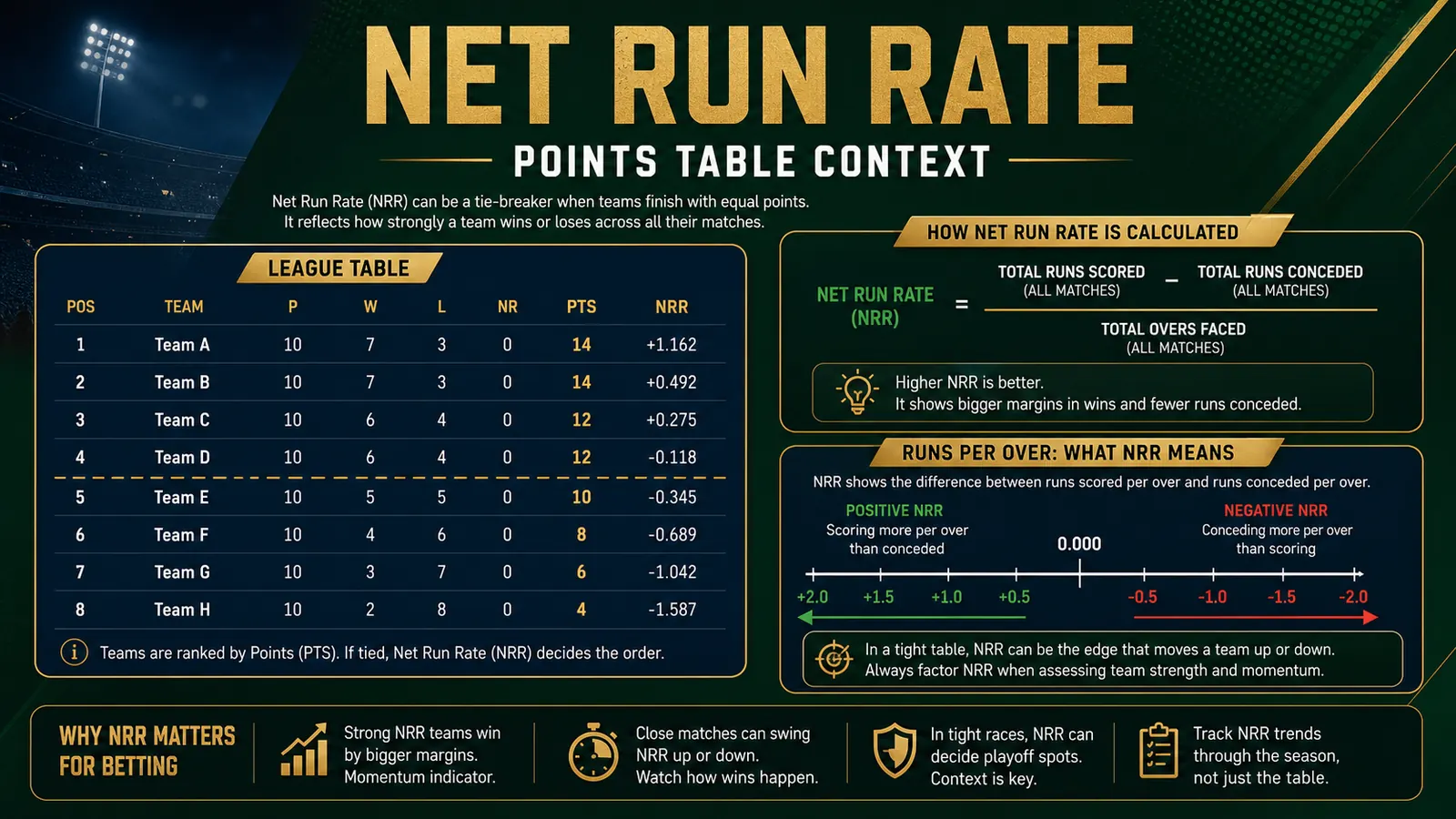
Net run rate is a league-table measure, not a prediction of what will happen in one innings. It compares scoring rates and conceding rates across matches, subject to the competition rules and the way completed innings are counted.
For betting context, NRR can help explain why a team approaches a late league match with urgency. It should not be lifted from the table and treated as a stand-alone reason for a market choice.
Editorial note: Reviewed by IPL Betting Editorial Team. Last updated: August 2026. Evidence method: compare published competition rules, current match information, and the exact market terms shown by your chosen platform. Match information, team news, weather, prices, and market terms can change, so keep every decision within a planned limit.
The Basic NRR Idea
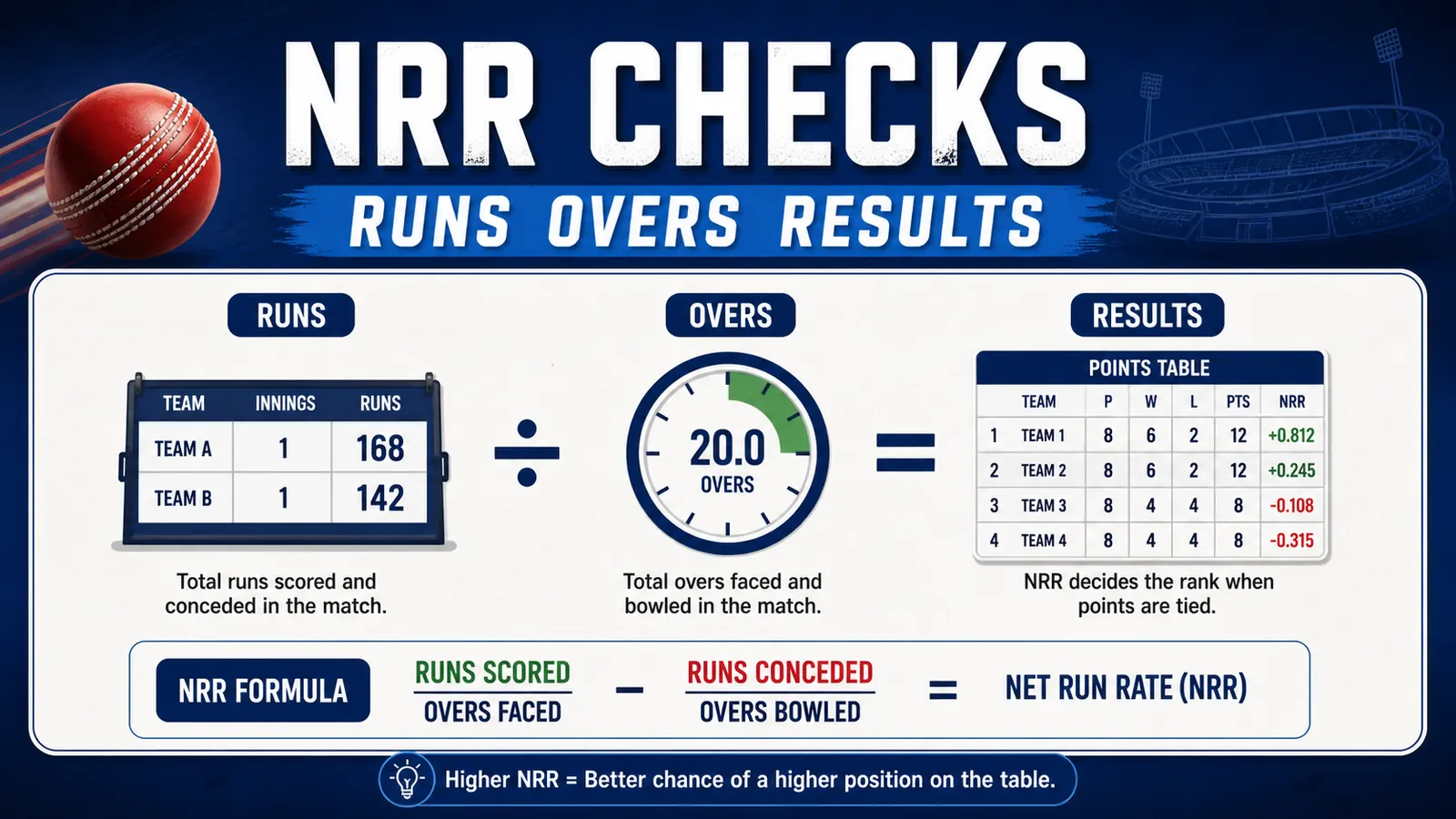
At a high level, a team’s net run rate compares the rate at which it scores with the rate at which it concedes. Runs and overs matter together, so a raw total is not enough.
The official competition rules decide how shortened matches, all-out innings, and other edge cases are counted. Use the published table and rule explanation rather than recreating a complicated situation from memory.
| Table item | What it tells you | Do not confuse it with |
|---|---|---|
| Points | Results accumulated in the league | A guarantee for the next match |
| NRR | Relative scoring-rate context | A player strike rate |
| Runs for | Team scoring output counted by rules | One innings total |
| Runs against | Runs conceded in counted matches | A current market line |
Read the Points Table in Context
A team near a qualification line may have a different objective from a team already secure. That context can affect tactics, but it does not remove the normal uncertainty of a T20 match.
Check the number of matches played, remaining fixtures, and tie-break rules. Comparing NRR across teams with different schedules can lead to an incomplete conclusion.
| Context | Question | Better interpretation |
|---|---|---|
| Matches played | Have teams played the same number? | Compare like stages |
| Qualification line | What result is needed under the rules? | Read the table, not a slogan |
| Remaining fixtures | Who still has matches left? | Avoid treating the table as final |
| Tie-breaker | Which rule applies if points match? | Check the current competition rules |
Connect League Context to the Match Carefully
A team needing a result may choose a more aggressive approach, while another may value control. That is a tactical possibility, not a fixed outcome.
If you use table context, write exactly what it changes: urgency, rotation choices, or the value of a cautious chase. Do not let the points table replace lineup, venue, toss, and market checks.
Avoid the Single-Number Shortcut
NRR can summarize a long sequence of matches, but it may hide schedule strength, changing lineups, and different venues. Use it as one context marker and keep the limitations visible.
The best question is not “Which NRR is higher?” It is “What does the table require today, and which current evidence supports that interpretation?”
FAQ
What is net run rate?
It is a competition table measure comparing a team’s scoring rate with the rate at which it concedes, according to the applicable rules.
Can NRR predict the next match?
No. It provides league context but does not replace current lineup, venue, toss, weather, and market checks.
Why do matches played matter?
Teams with different numbers of matches can be at different stages, so their points and NRR need context.
What should be checked when points are level?
Read the current competition tie-break rules and confirm how NRR is being applied.
Source and update note: This evergreen guide should be checked against current official match information, published competition rules, and the exact market terms shown by your chosen platform before you act.
Related Reading
- IPL Stats for Betting Guide ↗
- IPL Betting Prediction Checklist ↗
- IPL Run Chase Betting Guide ↗
- IPL Team Total Runs Guide ↗
Take a pause when a material input is unconfirmed or a market rule is unclear. Clear information and a planned limit are more important than forcing a decision.