
Published by IPL Betting. Sources checked on 11 September 2026; examples are illustrative.
A fielder leaps over the rope, pushes the ball back and a teammate catches it. The crowd celebrates, but the replay keeps running. That extra footage matters: a boundary decision can depend on the first fielder’s later landing, not just the instant when the second player holds the ball.
This guide uses the ICC Men’s T20 World Cup 2026 playing conditions for boundary catches. It does not claim that every competition adopted the same provisions on the same date. In particular, an old highlight cannot be judged fairly by quietly applying a later rule to it.
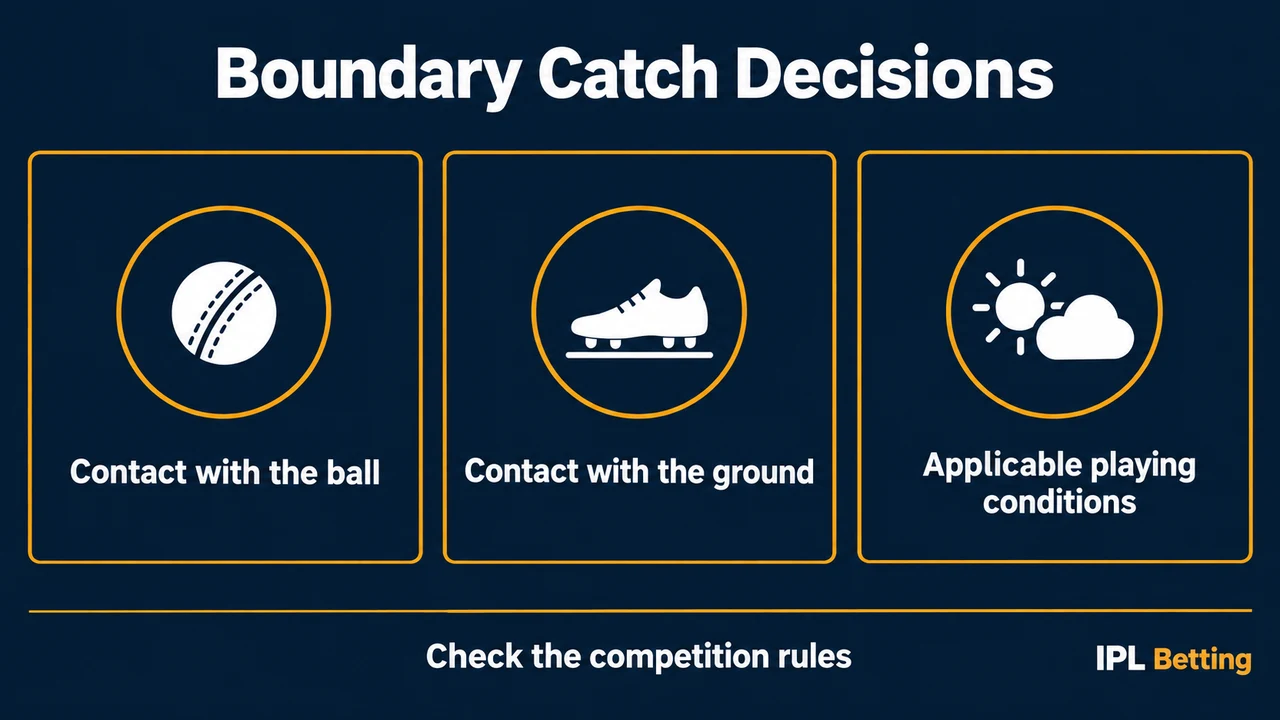
First establish whether the ball reached the ground
Under MCC Law 19, a boundary six requires the ball to have been struck by the bat and to reach beyond the boundary without first touching the ground inside the field. A bouncing shot reaching the boundary is different. For a catch, Law 33 requires the applicable fair-catch conditions and control of both the ball and the fielder’s movement.
Begin a replay with the ball, not the celebrating player. Did it bounce before arriving? Was there contact with the bat? Then identify the boundary marker. Locate the boundary rope or marker rather than using a background advertising board as the boundary. If the relevant contact is hidden, the clip may not contain enough evidence for your own conclusion.
| Plain example | Result to distinguish |
|---|---|
| A bat-struck ball bounces inside, then crosses the boundary. | Boundary four rather than six. |
| A bat-struck ball crosses and first grounds beyond the boundary. | Boundary six, subject to the applicable conditions. |
| A legal delivery is fairly caught before it grounds. | A catch, rather than boundary runs. |
Those are deliberately simple cases. They leave aside penalties, overthrows and unusual objects. Establishing the ordinary sequence makes the more complicated boundary relay easier to follow, because you know which extra fact is now in dispute.
A player touching the rope is not wholly inside
The ICC Men’s T20 World Cup 2026 conditions, clauses 19.4–19.5 address a fielder touching the boundary, ground beyond it or specified objects and other fielders outside it. A player holding the ball while grounded beyond the boundary cannot turn that contact into a fair boundary catch merely by jumping back afterwards.
Watch the feet and the ball together. If the camera alternates between them, do not pretend the edit proves simultaneous contact. The relevant question is what was touching what at the same moment. That is why a close angle can be useful for the shoe while another angle is needed to locate the ball.
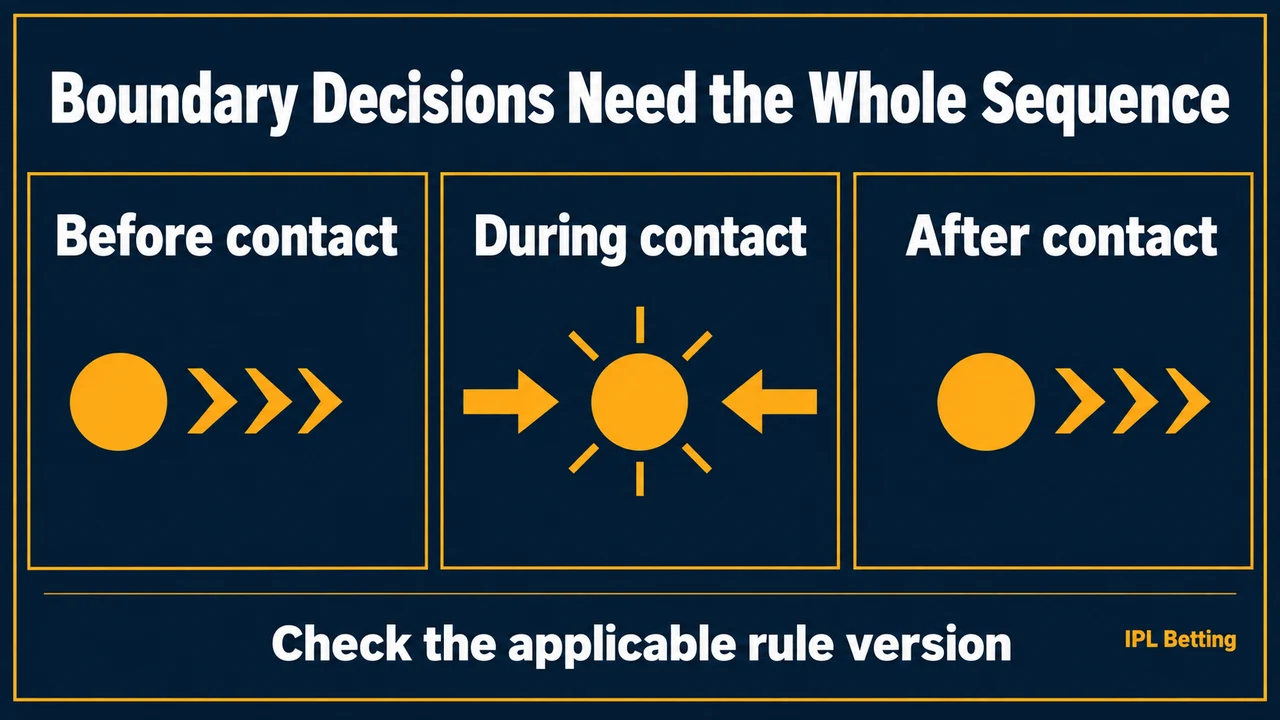
Why the landing after an airborne touch matters
The ICC’s 2025 explanation of its playing-condition changes describes the tightened boundary-catching provision: after an eligible first touch, a fielder making a further airborne touch from outside must land and remain inside. Another player completing the catch does not remove that obligation. The 2026 tournament document contains the detailed wording.
Think of the replay as one continuous sequence. Mark the first touch, any departure beyond the boundary, the airborne return touch and the landing. Keep watching after the ball reaches the teammate. Stopping the clip at the second player’s catch discards exactly the part that may decide whether the first player complied.
| Replay checkpoint | Question to ask |
|---|---|
| First contact | Where was the fielder’s final ground contact before touching the ball? |
| Airborne contact after leaving the field | Does it meet the named competition’s conditions? |
| Landing and later movement | Does that player land and remain inside until the ball is dead? |
| Catch completion | Has control been achieved, with no earlier boundary failure? |
An invented relay, viewed two ways
In this teaching example, a player makes an eligible initial touch from inside, steps beyond the boundary, then jumps and taps the airborne ball towards a teammate. In version A, that player lands wholly inside and stays there while the teammate completes a fair catch. In version B, the first player lands outside. The teammate’s actions look identical, but the first player’s landing changes the assessment under the named ICC rule.
The example is useful because it isolates one variable. It is not a verdict on any real highlight. A real decision also needs confirmation that the initial touch was eligible and that no other boundary contact occurred. A clip showing only the final two seconds cannot establish whether the first touch was eligible.
Check the date before arguing about an old clip
MCC announced that its new general Laws edition takes effect on 1 October 2026, while noting that some governing bodies had already adopted changes through playing conditions. See MCC’s effective-date announcement. A rule can be published before the date when it starts to apply.
When sharing a replay, include the competition and match date. Then link the relevant conditions, rather than a current rule page with no explanation. This gives other readers a way to test the claim. “That would be out today” and “the officials were wrong then” are not interchangeable statements.
Common questions
Is crossing the rope in the air automatically a six? No. The grounding and contact sequence matters; use the relevant competition’s conditions.
Can a teammate’s catch fix an earlier boundary? No. Once the applicable boundary condition has occurred, a later catch cannot undo it.
Can I decide from one still image? Often not. First contact, subsequent landing and control occur across time.
Our fours and sixes guide covers the related statistic. Read the basic cricket rules and scorecard guide for the surrounding terminology.