
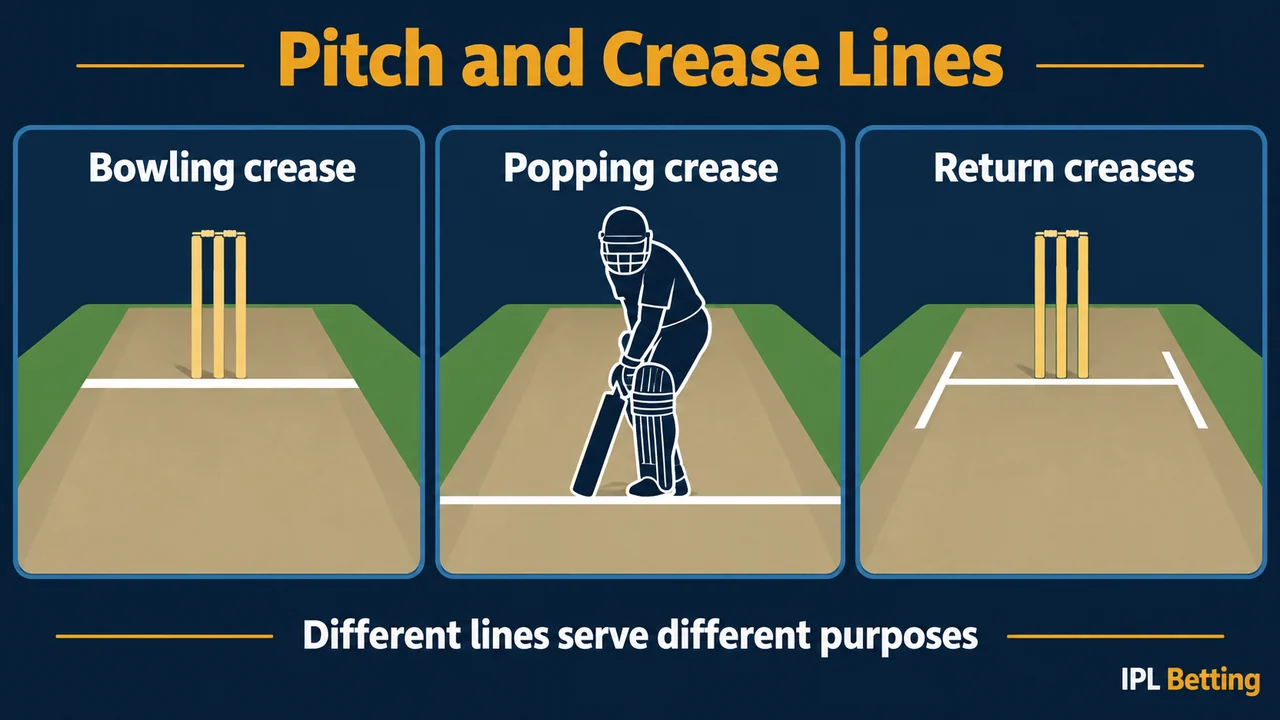
A replay zooms into a white line beside the bowler’s shoe. Later, another white line appears under a sliding batter’s bat. They are different reference points; the name and relevant edge of the line must come first. Start by identifying the bowling crease, popping crease, and return creases before trying to follow the decision.
The painted lines help define the playing area and the relevant edges. They do not all answer the same question, and touching visible paint is not a complete explanation of every no-ball or run-out.
The pitch is the strip, not the entire ground
MCC Law 6 defines the standard pitch as a rectangle 22 yards long and 10 feet wide. The ground surrounding it is a different area. A commentator calling a venue a “small ground” is usually discussing boundaries, not shortening that standard pitch.
Draw a long rectangle on paper and put a set of stumps at each end. That sketch is enough to place the crease markings. You do not need a detailed stadium plan or knowledge of field-position names to follow the basic geometry.
Three crease types, three labels
Under MCC Law 7, the bowling crease marks the pitch end. The popping crease is parallel to it and 4 feet in front. Two return creases run at right angles on either side, 4 feet 4 inches from the centre line. The law specifies the relevant edge of each marking.
| Marking | Position in a simple sketch | Relevant edge |
|---|---|---|
| Bowling crease | Across the pitch end. | Back edge of the marking. |
| Popping crease | Parallel, in front of the bowling crease. | Back edge of the marking. |
| Return creases | Along the sides, perpendicular to the popping crease. | Inside edges of the markings. |
The table is a label key. The law also describes minimum painted lengths and lines treated as extending beyond the visible paint. Do not assume that an unpainted extension has stopped existing for the relevant rule.
When sketching, label the edges with words rather than colouring the entire white strip as one boundary. That prevents the common mistake of measuring from whichever side of the paint happens to look clearest on television.
The delivery foot checks in MCC Law 21.5 use the popping crease for the front foot and the return crease for the back foot, with the stated conditions. That is why identifying the line comes before judging the shoe. “The foot was past a white line” leaves out which test is being applied.
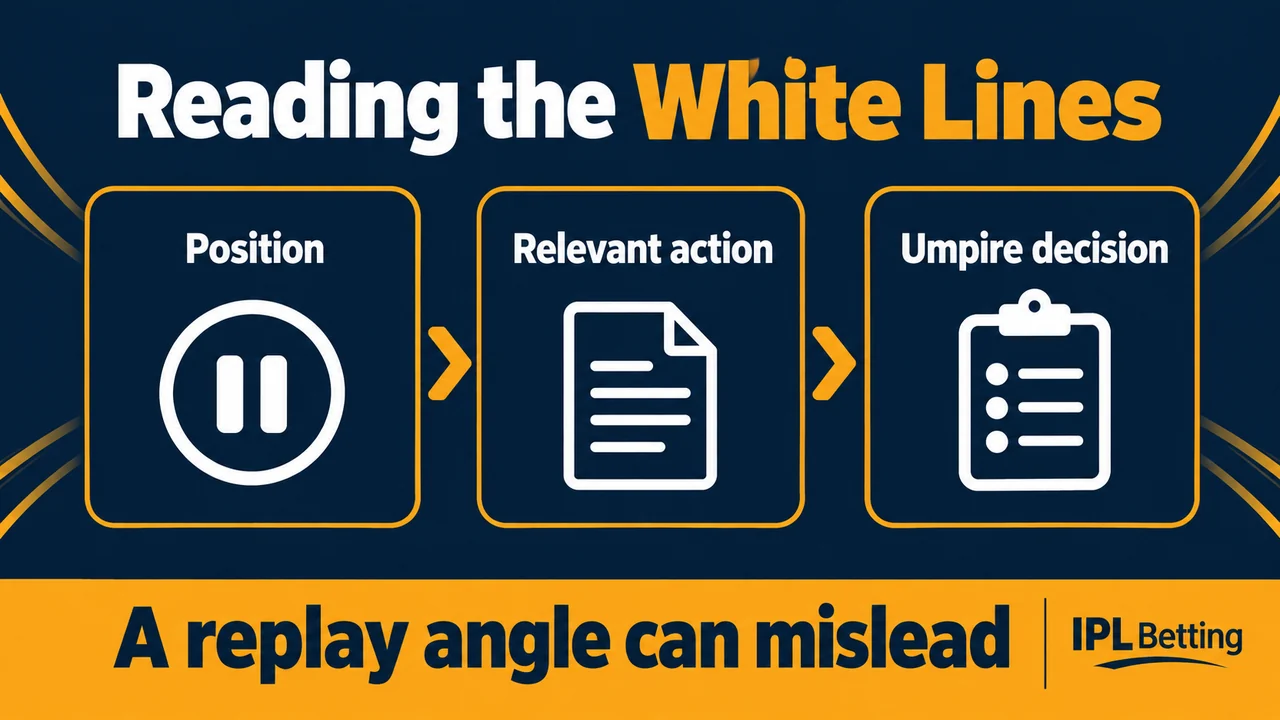
A camera angle can hide the edge you need
Imagine a front-on replay showing the width of a white strip but not the shoe’s relation to its back edge. Write “edge unclear,” even if the picture looks sharp. A sharp image can still hide the relevant edge behind the shoe.
A second invented image shows a bat reaching past the painted popping crease, but the contact with the ground is hidden by dust. That image identifies the area of the question without answering the grounding question. Naming the right line is step one, not the whole verdict.
Watch the full sequence once, then identify the relevant line and instant. If the replay begins after the wicket has been disturbed, it may omit the moment needed for the decision. A bat resting safely behind the crease afterwards does not establish its position when the wicket was broken.
Use measurements for a diagram, not a television verdict
The standard distances are useful for making a schematic. They are poor tools for measuring a broadcast frame by eye: perspective stretches some parts and compresses others. A line that appears closer on screen has not necessarily been marked at the wrong distance.
For an illustrative sketch, keep the two ends symmetrical and show the popping crease in front of each set of stumps. Add arrows saying “towards the other end” instead of relying on the page’s top and bottom. The sketch then remains understandable when the broadcast changes its camera position.
What this map leaves for another guide
Field geography uses the striker’s stance and direction, whereas this map identifies the fixed markings. Our field-position introduction covers that separate task; follow the basic rules guide for innings structure.
A venue’s bounce, drainage, or scoring history does not change which crease is being discussed. Keep physical markings separate from a pitch-quality claim. For an actual match, use the applicable competition rules and official ruling; a newer general law edition should not be applied silently to an old clip.
Source and method: Prepared by IPL Betting Editorial Team from the linked official material. The viewing exercises are invented, not match records. MCC’s 2026 Laws took effect on October 1; that date alone does not establish IPL adoption. For a specific fixture, check its season’s playing conditions.
For surrounding context: Cricket rules made simple; Cricket Field Positions: Reading the Ring, Slips, and Boundary Riders; Cricket Rules Made Simple for IPL Fans in the Philippines; IPL Venue Betting Guide: Pitch, Boundary Size, and Scoring Context.