
The first innings ends and the broadcast cuts to analysis. A graphic says the chase needs 171; a presenter mentions a restart time; rain begins near the ground. Those are three different pieces of information. The first-innings total can be final while the chase’s start time and allocation are still unsettled.
During an innings break, carry forward the completed score, then check the target, the permitted innings length and the announced restart. You do not need to predict what the chase will look like. You need to know what officials have confirmed before the first delivery.
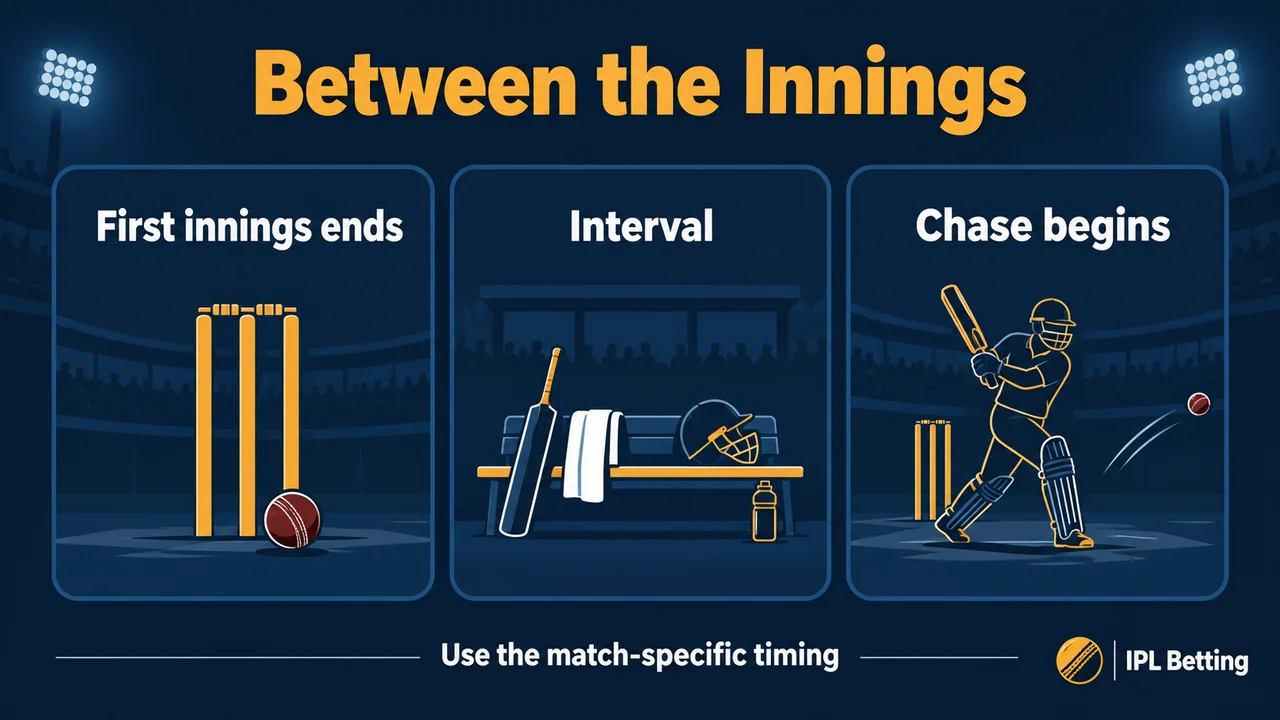
Recognise the transition
In a normal one-innings-per-side match, the team that batted now fields and the other side bats. An innings can end before its full allocation is used, so do not wait for the final scheduled over as your only clue. Listen for the announcement that the innings is complete.
A drinks break or a treatment pause within an innings is a different event. The batting side usually resumes the same innings. A graphic disappearing during advertisements does not itself establish that the teams have changed roles. Check the innings number and the next pair of batters when the broadcast returns.
The general law is not an IPL countdown
MCC’s Law 11 on intervals gives a ten-minute general interval between innings, with provisions that can combine it with other intervals or interruptions. It also requires the scorers to be informed of relevant agreements and changes. This is a general-law reference, not a claim that the current IPL innings break always lasts ten minutes.
Leagues and tournaments use playing conditions that can set their own arrangements. For the match you are watching, use the competition’s current document and the official restart announcement. An old broadcast countdown from another league is not a substitute. No fixed current-season IPL break duration is asserted here.
A break card with four separate fields
| Field | Write down | Why it is separate |
|---|---|---|
| Completed innings | Official total and wickets | This is the record of the innings just finished. |
| Target | Announced number required to win | It may be revised after an interruption. |
| Allocation | Overs or balls available for the chase | It may differ from the original full match. |
| Restart | Announced time and any revision | Your television feed can also run behind real time. |
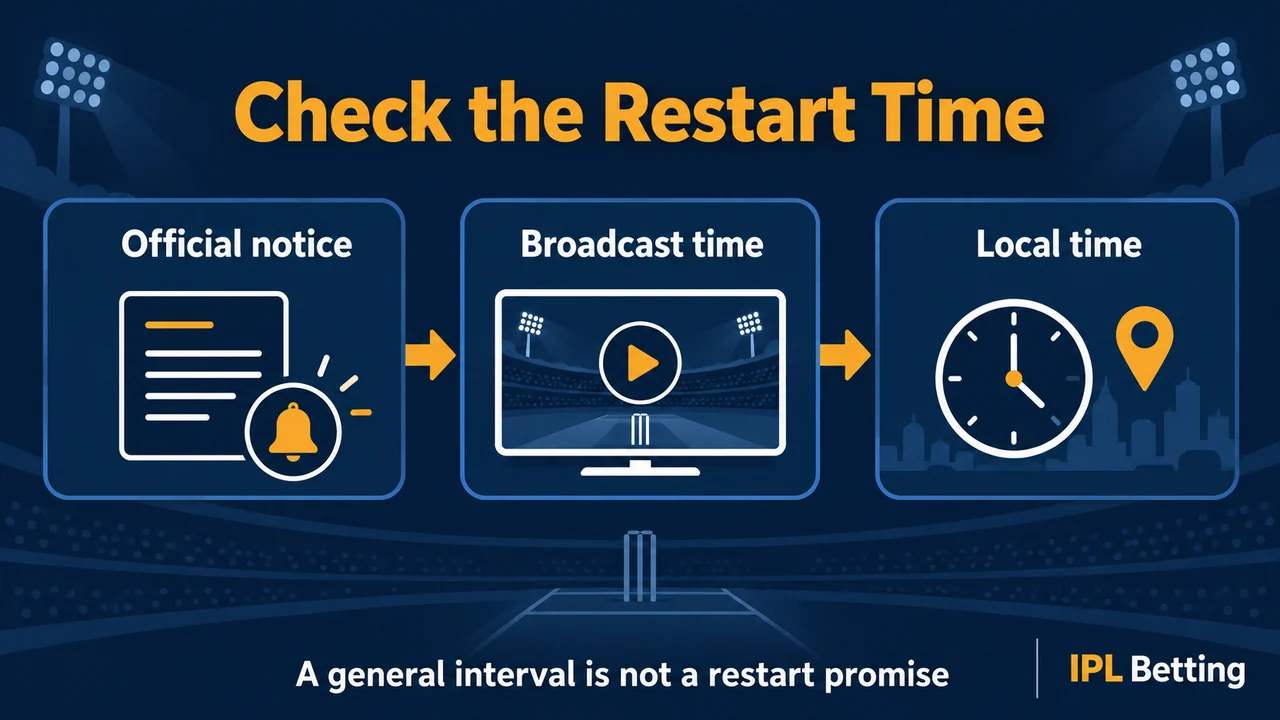
If one field is not confirmed, leave it open. Writing “restart not yet announced” is more useful than an exact time calculated from a remembered break length. Update a revised field rather than keeping both values without labels.
A straightforward change of innings
Consider a fictional uninterrupted match. Team A finishes on 170 for seven. Under an ordinary chase with no special adjustments, Team B needs 171 to exceed that score. Your note can show the completed 170 and the target 171 together; they are not competing versions of one number.
When the break ends, confirm the batting side and the scoreboard’s target. Check that a replay of Team A’s final over is not being mistaken for Team B’s live first over. A caption saying “highlights” or “earlier” matters when the camera sequence looks continuous.
The useful first-ball preparation is modest: know who is batting, which score is being chased and whether the innings allocation is unchanged. Team-selection and substitution questions should be checked through the match’s announced lineups and competition conditions, rather than inferred from which player is visible warming up.
Now add an interruption
Use a second invented scenario: rain begins after Team A’s 170 is confirmed. The broadcast first displays the original chase target, then says officials are considering a shorter allocation. The old target remains an historical screen value; it does not settle the revised chase.
Wait for the new official target and allocation. Record the pair together. If the app shows 171 while the stadium announcement gives another target, check which feed has the later update and which one identifies the revision. Do not calculate a new target by simply scaling 170 to a smaller number of overs.
There can also be a revised restart without a revised target. A delay changes the clock before it necessarily changes the scoring task. Conversely, a shortened chase may alter both. Keeping separate fields lets you describe either situation without assuming every pause has the same effect.
Plan your own viewing time
For fans in the Philippines, keep local time separate from the stadium’s displayed time zone. An alarm is a reminder to check the broadcast, not evidence that play resumed. If you return late, begin with the current innings and over rather than trying to reconcile every advertisement you missed.
When the commentary is uncertain
“Expected to resume” is an estimate. “Play will resume at” may report an official decision, but its source still matters. Listen for attribution to the umpires or organiser and for later revisions. A projected score supplied by an analyst belongs in another category again: it is not the official target.
This short break routine avoids carrying first-innings assumptions into the chase. It also gives you enough context to enjoy the next phase without treating the pause as pressure to make a betting decision.
Related reading: Cricket rules introduction; Slow Over Rates in T20 Cricket: Fielding Penalties and Match Delays; IPL Run Chase Betting Guide: Required Rate, Wickets in Hand, and Chasing Pressure.
Prepared by IPL Betting Editorial Team. Updated 4 October 2026. The linked official materials support the rules identified in this guide. Match examples are invented exercises, and a competition’s published conditions can differ from the general Laws.